

Tuesday, June 15, 2010


Friday, June 11, 2010
New Test Logo for the MALAS Program @ SDSU

 ...oh and be sure to check out the new addition to our main website--a cool, retro, vhs-malas label image...
MALAS Students! How About a Fulbright!????

Date: Fri, 11 Jun 2010 10:37:18 -0700 (PDT)
From: William Nericcio
To: "MALAS-HR":;
Subject: MALASheads! Headsup....: MALAS-HR
SDSU is sending more Fulbright Scholars abroad next year than ever before--9 SDSU Graduate Students and Undergraduates hit a big one out of the park and won these prestigious prizes for 2010-2011.
No reason MALAS gradaute students should not be winning these Fulbrights as well; the upside of going through the application process with Super Professor Pat Huckle? It is like a tutorial for HOW TO APPLY to anything for the rest of your life--she is that amazing! Read on....
Date: Wed, 9 Jun 2010 16:53:48 -0700
To: advisers, calfolk
From: Patricia Huckle
Subject: Summer Fulbright Sessions
Dear Colleagues:
To see the wonderful picture of Linda Richardson (Spain, flamenco) and story about the nine Student Fulbright grants, go here.
We have scheduled Student Fulbright Information Sessions (all from 4-530 p.m.):
Tuesday, June 22 in West Commons 201;
Thursday, July 22 in Arts and Letters 201;
Wednesday, July 28 in AL 201;
Tuesday, August 17 in AL 101;
Monday, August 23 in AL 201.
All are scheduled from 4-530 p.m. To reserve a space, go here.
Please encourage interested students to attend. Your support is crucial to the success of the Fulbright program on campus. Students may also contact me at: huckle@mail.sdsu.edu
Patricia Huckle, Prof. Emerita
SDSU Fulbright Adviser
AL 338
Yours,
Bill Nericcio, Director
MALAS
Wednesday, June 9, 2010
Looking for a Cultural Studies MA in Southern California or San Diego?
 If you are looking for an interdisciplinary, cultural studies program based out of Southern California, make it a point to research the most eclectic, dynamic, over-achieving master's degree program this side of the Mississippi: The Master of Arts in Liberal Arts and Sciences Program at San Diego State University. Click Michel Foucault's shining pate for more info or point your browser here.
Friday, June 4, 2010


People are Flocking to MALAS...

Tuesday, June 1, 2010
MALAS: The Master of Liberal Arts and Sciences, SDSU | Catalogue Copy
SDSU GRADUATE BULLETIN 2008-2009
Liberal Arts and Sciences
In the College of Arts and Letters
OFFICE: Nasatir Hall 203
TELEPHONE: 619-594-4826 / FAX: 619-594-1325
E-MAIL:
http://www.malas.sdsu.edu
Director: William A. Nericcio
Program Coordinator: David McHenry
Participating Faculty
Susan E. Cayleff, Ph.D., Professor of Women’s Studies
Patricia J. Geist-Martin, Ph.D., Professor of Communication
Dipak K. Gupta, Ph.D., Professor of Political Science
D. Emily Hicks, Ph.D., Professor of English and Comparative Literature
and Chicana and Chicano Studies
Linda D. Holler, Ph.D., Professor of Religious Studies and Associate
Dean of the College of Arts and Letters
Alan E. Kilpatrick, Ph.D., Professor of American Indian Studies
William A. Nericcio, Ph.D., Professor of English and Comparative
Literature
Steven L. Barbone, Ph.D., Associate Professor of Philosophy
Jung Min Choi, Ph.D., Associate Professor of Sociology
Stephen A. Colston, Ph.D., Associate Professor of History
Elizabeth A. Colwill, Ph.D., Associate Professor of Women’s Studies
Sarah S. Elkind, Ph.D., Associate Professor of History
Ellen Quandahl, Ph.D., Associate Professor of Rhetoric and Writing
Studies
Sandra A. Wawrytko, Ph.D., Associate Professor of Philosophy
Kathy S. Williams, Ph.D., Associate Professor of Biology
Sthaneshwar Timalsina, Ph.D., Assistant Professor of Religious
Studies
John and Jane Adams Endowment
John R. Adams was an esteemed faculty member of San Diego
State University from 1928 until his retirement in 1968, whereupon he
accepted the position of University Archivist. Dr. Adams was a
professor of English and chair of the Division of Humanities. He and
Jane Adams were generous benefactors to SDSU throughout their
lives and they established a Charitable Living Trust to be used to
promote liberal education. Today some of those funds are used in the
MALAS program to support graduate assistantships and to help pay
for academic retreats, workshops, and lectures. In addition, MALAS
has arrangements with two sister institutions, the University of
Maastricht in The Netherlands and Simon Fraser University in Canada,
to convene an annual conference that revolves among the three sites.
Funds from the Adams Endowment are used to send students to
present papers at Maastricht and Simon Fraser.
General Information
The College of Arts and Letters offers a flexible multidisciplinary
master’s degree in the liberal arts and sciences. An alternative
approach to traditional graduate education, the program consists of
coursework that crosses disciplinary boundaries so as to better
appreciate the richness of existence and begin to apply multiple perspectives
to the complex realities that face us. From explorations of
the human condition to the social impacts of technology, the program
focuses on issues central to the meaning and quality of our lives and
the creation of sustainable, just, communities.
In existence since 1987, the Master of Arts in Liberal Arts and
Sciences is equally well suited to students who recently achieved the
bachelor’s degree, students preparing for the Ph.D., professionals for
whom the master’s degree may mean promotion or career advancement,
and life-long learners in search of personal enrichment and
intellectual community. We welcome applications from K-12 teachers,
community activists, and policy makers.
MALAS draws upon SDSU faculty who are trained in disciplines
but whose teaching and scholarship makes connections across disciplines.
Interplays among the humanities, the social sciences, the
natural sciences, and the arts are taken up in four required courses.
These seminars seek to understand contemporary life and construct
positive futures but they also push the level of discourse to foundational
questions of epistemology and perennial philosophy, such as
the existence of truth, goodness, and beauty. Particular attention is
given to understanding the psychological, economic, and environmental
consequences of globalization, and to the ways that human
values are embodied in and transformed by modes of consumption,
labor, and material culture. The four core courses act to ground and
center five elective courses, selected by each student to customize a
program that captures his or her interests.
Admission to Graduate Study
In addition to satisfying the requirements for admission to the
university with classified graduate standing as described in Part Two
of this bulletin, the student seeking admission must: (1) have a grade
point average of 3.0 or better on work completed during the last 60
units for the baccalaureate degree, (2) have an acceptable score on
the GRE General Test (combined verbal and quantitative), and (3)
complete a statement of purpose essay. A personal interview with the
director is recommended.
Students applying for admission should electronically submit the
university application available at http://www.csumentor.edu along
with the $55 application fee.
All applicants must submit admissions materials separately to
SDSU Graduate Admissions and to Master of Arts in Liberal Arts and
Sciences.
Graduate Admissions
The following materials should be submitted as a complete
package directly to:
Graduate Admissions
Enrollment Services
San Diego State University
San Diego, CA 92182-7416
(1) Official transcripts (in sealed envelopes) from all
postsecondary institutions attended;
Note:
• Students who attended SDSU need only submit transcripts
for work completed since last attendance.
• Students with international coursework must submit both
the official transcript and proof of degree. If documents
are in a language other than English, they must be
accompanied by a certified English translation.
(2) GRE scores (http://www.ets.org, SDSU institution code 4682);
(3) TOEFL score, if medium of instruction was in a language other
than English (http://www.ets.org, SDSU institution code 4682).
Master of Arts in Liberal Arts and Sciences
The following materials should be submitted by November 1
(October 1 for international students) for admission for the spring
semester and May1 for the fall semester to:
William Nericcio, Director
Master of Arts in Liberal Arts and Sciences
San Diego State University
5500 Campanile Drive
San Diego, CA 92182-8137
(1) Statement of purpose essay
(2) Writing Sample (10 to 25 pages, maximum)
(3) A paragraph wherein you define your vision of interdisciplinary studies, liberal arts, the humanities or cultural studies.
Liberal Arts and Sciences
SDSU GRADUATE BULLETIN 2008-2009
Advancement to Candidacy
All students must satisfy the general requirements for
advancement to candidacy as described in Part Two of this bulletin. In
addition, the students must (1) satisfactorily complete 12 units, with a
minimum grade point average of 3.0, including 9 units of core
seminars as stipulated (MALAS 600A, 600B, 600C, 600D) and (2)
have a thesis or project proposal which has received the approval of
the Graduate Liberal Arts and Sciences Committee and its director.
Specific Requirements for the Master of
Arts Degree in Liberal Arts and Sciences
(Major Code: 49017)
In addition to meeting the basic requirements for the Master of Arts
degree in Liberal Arts and Sciences as described in Part Two of this
bulletin, the student must complete a graduate program of 30 units, 15
units of which must be in 600- and 700-level courses. Up to 15 units of
coursework can be taken at the 500-level. The total program includes:
1. MALAS 601 (3).
2. MALAS 600A, 600B, 600C, or 600D in any combination (9
units). Each course may be repeated once with new content
and, in excess of nine units, can be used for elective credit.
3. MALAS 799A (3): Thesis or Project.
4. 15 units of electives selected with approval of the MALAS director.
All programs must be approved by the MALAS director in consultation
with the Graduate Liberal Arts and Sciences Committee.
Courses Acceptable on Master’s Degree
Program in Liberal Arts and Sciences (MALAS)
Refer to Courses and Curricula and Regulations of the Division of Graduate
Affairs sections of this bulletin for explanation of the course numbering
system, unit or credit hour, prerequisites, and related information.
GRADUATE COURSES
MALAS 600. Interdisciplinary Study in Liberal Arts and
Sciences (3-3-3-3)
Prerequisite: Graduate standing.
MALAS seminars are divided into four general areas with content
that varies semester to semester. Each course may be repeated once
with new content. See Class Schedule for specific content. Maximum
credit six units for each of the following courses: MALAS 600A, 600B,
600C, 600D.
A. Cultural Studies
B. Science and Society, Environmental Studies
C. Globalization, Technology, Future Studies
D. Media Studies, Fine Arts, Transformative Arts
MALAS 601. Seminar in Interdisciplinary Thinking (3)
Prerequisites: Graduate standing.
Nature of interdisciplinary thinking. Ways of knowing and schools
of thought in multiple disciplines. Interdisciplinary methods to analyze
social issues. See Class Schedule for specific content.
MALAS 798. Special Study (3) Cr/NC/RP
Prerequisites: Graduate standing.
Individual study on a given topic through interdisciplinary
perspectives.
MALAS 799A. Thesis or Project (3) Cr/NC/RP
Prerequisites: An officially appointed thesis committee and
advancement to candidacy.
Preparation of a project or thesis for Master of Arts degree in
Liberal Arts and Sciences.
MALAS 799B. Thesis or Project Extension (0) Cr/NC
Prerequisites: Prior registration in Thesis or Project 799A with an
assigned grade symbol of RP.
Registration required in any semester or term following assignment
of RP in MALAS 799A in which the student expects to use the facilities
and resources of the university; also student must be registered in the
course when the completed thesis or project is granted final approval.
Liberal Arts and Sciences
In the College of Arts and Letters
OFFICE: Nasatir Hall 203
TELEPHONE: 619-594-4826 / FAX: 619-594-1325
E-MAIL:
http://www.malas.sdsu.edu
Director: William A. Nericcio
Program Coordinator: David McHenry
Participating Faculty
Susan E. Cayleff, Ph.D., Professor of Women’s Studies
Patricia J. Geist-Martin, Ph.D., Professor of Communication
Dipak K. Gupta, Ph.D., Professor of Political Science
D. Emily Hicks, Ph.D., Professor of English and Comparative Literature
and Chicana and Chicano Studies
Linda D. Holler, Ph.D., Professor of Religious Studies and Associate
Dean of the College of Arts and Letters
Alan E. Kilpatrick, Ph.D., Professor of American Indian Studies
William A. Nericcio, Ph.D., Professor of English and Comparative
Literature
Steven L. Barbone, Ph.D., Associate Professor of Philosophy
Jung Min Choi, Ph.D., Associate Professor of Sociology
Stephen A. Colston, Ph.D., Associate Professor of History
Elizabeth A. Colwill, Ph.D., Associate Professor of Women’s Studies
Sarah S. Elkind, Ph.D., Associate Professor of History
Ellen Quandahl, Ph.D., Associate Professor of Rhetoric and Writing
Studies
Sandra A. Wawrytko, Ph.D., Associate Professor of Philosophy
Kathy S. Williams, Ph.D., Associate Professor of Biology
Sthaneshwar Timalsina, Ph.D., Assistant Professor of Religious
Studies
John and Jane Adams Endowment
John R. Adams was an esteemed faculty member of San Diego
State University from 1928 until his retirement in 1968, whereupon he
accepted the position of University Archivist. Dr. Adams was a
professor of English and chair of the Division of Humanities. He and
Jane Adams were generous benefactors to SDSU throughout their
lives and they established a Charitable Living Trust to be used to
promote liberal education. Today some of those funds are used in the
MALAS program to support graduate assistantships and to help pay
for academic retreats, workshops, and lectures. In addition, MALAS
has arrangements with two sister institutions, the University of
Maastricht in The Netherlands and Simon Fraser University in Canada,
to convene an annual conference that revolves among the three sites.
Funds from the Adams Endowment are used to send students to
present papers at Maastricht and Simon Fraser.
General Information
The College of Arts and Letters offers a flexible multidisciplinary
master’s degree in the liberal arts and sciences. An alternative
approach to traditional graduate education, the program consists of
coursework that crosses disciplinary boundaries so as to better
appreciate the richness of existence and begin to apply multiple perspectives
to the complex realities that face us. From explorations of
the human condition to the social impacts of technology, the program
focuses on issues central to the meaning and quality of our lives and
the creation of sustainable, just, communities.
In existence since 1987, the Master of Arts in Liberal Arts and
Sciences is equally well suited to students who recently achieved the
bachelor’s degree, students preparing for the Ph.D., professionals for
whom the master’s degree may mean promotion or career advancement,
and life-long learners in search of personal enrichment and
intellectual community. We welcome applications from K-12 teachers,
community activists, and policy makers.
MALAS draws upon SDSU faculty who are trained in disciplines
but whose teaching and scholarship makes connections across disciplines.
Interplays among the humanities, the social sciences, the
natural sciences, and the arts are taken up in four required courses.
These seminars seek to understand contemporary life and construct
positive futures but they also push the level of discourse to foundational
questions of epistemology and perennial philosophy, such as
the existence of truth, goodness, and beauty. Particular attention is
given to understanding the psychological, economic, and environmental
consequences of globalization, and to the ways that human
values are embodied in and transformed by modes of consumption,
labor, and material culture. The four core courses act to ground and
center five elective courses, selected by each student to customize a
program that captures his or her interests.
Admission to Graduate Study
In addition to satisfying the requirements for admission to the
university with classified graduate standing as described in Part Two
of this bulletin, the student seeking admission must: (1) have a grade
point average of 3.0 or better on work completed during the last 60
units for the baccalaureate degree, (2) have an acceptable score on
the GRE General Test (combined verbal and quantitative), and (3)
complete a statement of purpose essay. A personal interview with the
director is recommended.
Students applying for admission should electronically submit the
university application available at http://www.csumentor.edu along
with the $55 application fee.
All applicants must submit admissions materials separately to
SDSU Graduate Admissions and to Master of Arts in Liberal Arts and
Sciences.
Graduate Admissions
The following materials should be submitted as a complete
package directly to:
Graduate Admissions
Enrollment Services
San Diego State University
San Diego, CA 92182-7416
(1) Official transcripts (in sealed envelopes) from all
postsecondary institutions attended;
Note:
• Students who attended SDSU need only submit transcripts
for work completed since last attendance.
• Students with international coursework must submit both
the official transcript and proof of degree. If documents
are in a language other than English, they must be
accompanied by a certified English translation.
(2) GRE scores (http://www.ets.org, SDSU institution code 4682);
(3) TOEFL score, if medium of instruction was in a language other
than English (http://www.ets.org, SDSU institution code 4682).
Master of Arts in Liberal Arts and Sciences
The following materials should be submitted by November 1
(October 1 for international students) for admission for the spring
semester and May1 for the fall semester to:
William Nericcio, Director
Master of Arts in Liberal Arts and Sciences
San Diego State University
5500 Campanile Drive
San Diego, CA 92182-8137
(1) Statement of purpose essay
(2) Writing Sample (10 to 25 pages, maximum)
(3) A paragraph wherein you define your vision of interdisciplinary studies, liberal arts, the humanities or cultural studies.
Liberal Arts and Sciences
SDSU GRADUATE BULLETIN 2008-2009
Advancement to Candidacy
All students must satisfy the general requirements for
advancement to candidacy as described in Part Two of this bulletin. In
addition, the students must (1) satisfactorily complete 12 units, with a
minimum grade point average of 3.0, including 9 units of core
seminars as stipulated (MALAS 600A, 600B, 600C, 600D) and (2)
have a thesis or project proposal which has received the approval of
the Graduate Liberal Arts and Sciences Committee and its director.
Specific Requirements for the Master of
Arts Degree in Liberal Arts and Sciences
(Major Code: 49017)
In addition to meeting the basic requirements for the Master of Arts
degree in Liberal Arts and Sciences as described in Part Two of this
bulletin, the student must complete a graduate program of 30 units, 15
units of which must be in 600- and 700-level courses. Up to 15 units of
coursework can be taken at the 500-level. The total program includes:
1. MALAS 601 (3).
2. MALAS 600A, 600B, 600C, or 600D in any combination (9
units). Each course may be repeated once with new content
and, in excess of nine units, can be used for elective credit.
3. MALAS 799A (3): Thesis or Project.
4. 15 units of electives selected with approval of the MALAS director.
All programs must be approved by the MALAS director in consultation
with the Graduate Liberal Arts and Sciences Committee.
Courses Acceptable on Master’s Degree
Program in Liberal Arts and Sciences (MALAS)
Refer to Courses and Curricula and Regulations of the Division of Graduate
Affairs sections of this bulletin for explanation of the course numbering
system, unit or credit hour, prerequisites, and related information.
GRADUATE COURSES
MALAS 600. Interdisciplinary Study in Liberal Arts and
Sciences (3-3-3-3)
Prerequisite: Graduate standing.
MALAS seminars are divided into four general areas with content
that varies semester to semester. Each course may be repeated once
with new content. See Class Schedule for specific content. Maximum
credit six units for each of the following courses: MALAS 600A, 600B,
600C, 600D.
A. Cultural Studies
B. Science and Society, Environmental Studies
C. Globalization, Technology, Future Studies
D. Media Studies, Fine Arts, Transformative Arts
MALAS 601. Seminar in Interdisciplinary Thinking (3)
Prerequisites: Graduate standing.
Nature of interdisciplinary thinking. Ways of knowing and schools
of thought in multiple disciplines. Interdisciplinary methods to analyze
social issues. See Class Schedule for specific content.
MALAS 798. Special Study (3) Cr/NC/RP
Prerequisites: Graduate standing.
Individual study on a given topic through interdisciplinary
perspectives.
MALAS 799A. Thesis or Project (3) Cr/NC/RP
Prerequisites: An officially appointed thesis committee and
advancement to candidacy.
Preparation of a project or thesis for Master of Arts degree in
Liberal Arts and Sciences.
MALAS 799B. Thesis or Project Extension (0) Cr/NC
Prerequisites: Prior registration in Thesis or Project 799A with an
assigned grade symbol of RP.
Registration required in any semester or term following assignment
of RP in MALAS 799A in which the student expects to use the facilities
and resources of the university; also student must be registered in the
course when the completed thesis or project is granted final approval.
Monday, May 10, 2010
Fall 2010 MALAS Course Descriptions | An Amazing Menu of Courses
Never before has the Master of Arts in Liberal Arts and Sciences hosted such a broad array of interdisciplinary courses--despite the budget cuts, despite the gloom and doom, MALAS is attempting to emerge, like some bizarre Phoenix, from the ashes, and promises to have on tap for Fall 2010 a veritable smorgasbord of intellectual delights.
MALAS 600A
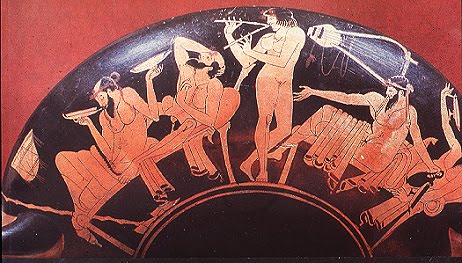
Symposium: Party Power
Dr. Joseph Smith, Associate Professor, The Department of Classics and Humanities, SDSU

 A deep meditation on the cultural institution of the symposium (> Lat. symposium > Gr. symposion, drinking together, a drinking party). With regard to symposia of the classical world, we’ll concern ourselves with who drank, what they drank, what they did while they were drinking, what they did after they drank all they could drink, and what happened in the cold, grey light of the next day. And then there’s Plato’s Symposium and Socrates to consider. That’s the guy who never seemed to get drunk, despite his intoxicating effect on his fellow symposiasts, and despite his satyr-like appetites.
 Plato’s Symposium commemorates Socrates (years after he had drunk hemlock), and we’ll consider the hangover that work has had on Western culture ever since. We’ll look for the persisting influence of the symposium and The Symposium (and we’ll find it in various and hugely diverse cultural expressions across Western history: literature and mass media, philosophy and religion, performing arts, and our own vintages).
 This semester-long dialogue will necessitate some unabashedly frank and profoundly revelatory conversations about the topic on the table within The Symposium–erotic love. So there: a seminar about wine and sex. See you this fall, Tuesday evenings @ 4:00pm. Till then, party on, Garth.
MALAS 600A | Sec 1 | SEM: SYMPOSIA PARTY POWER | 3 units | Sched#21800 | Seminar 4:00pm-6:40pm Tuesdays | SH-150 | DR. J. SMITH
MALAS 600D
The Rebel
Dr. Chris Frost, Associate Dean, Undergraduate Division, SDSU
 Why consider the “Rebel” as a topic or theme worthy of study? I think the answer to that question is rooted in an understanding of rebellion as a response to the human condition (in general), and a reaction to oppressive conditions (in particular). Framed in this initial manner—the Rebel as an individual who challenges the conditions of existence—we derive a theme that transcends cultures and epochs (time and space), and a theme that transcends any specific arena of protest. Thus, we can select from a wide range of sources as we seek characters that rebel against social convention, against socially constructed boundaries defined by gender, ethnicity and sexual orientation, against moral codes that move toward moral sadism,
 and against unyielding social hierarchies. The principle is nonetheless constant: there exists a subset of individuals (or characters, in literature and film) who perceive the dominant values of a social, cultural, political or religious system as irreconcilable with their own individual values, social roles, moral codes, and mental schemes. On a different level, we encounter the notion of rebellion writ large: a revolt against a universe that gives rise to life and consciousness, but that fails to provide meaning and fails to preserve consciousness. Perhaps the ultimate existential irony is this: it is the emergence of consciousness that allows us to be aware of our own mortality, while failing to provide us any solution to that mortality. In a very real sense, this existential condition confronts us with absurdity at every turn: we are aware of our demise, but helpless to do anything about it; the universe is imbued with no system of meaning, but meaning seems essential. For some, even the quest for meaning is something of a rebellion—a revolt against meaninglessness.
MALAS 600D | SEM: THE REBEL | 3 units | Sched#21801 | Seminar 4:00pm-6:40pm WEDNESDAYS | WAD-223 | DR. C.FROST
MALAS 601
Seminar in Interdisciplinary Thinking/Bordered Bodies: Aliens, Women, Cyborgs, and More...
Victoria Gonzalez Rivera, PhD, Assistant Professor, The Department of Chicana/o Studies, SDSU
 Our symbiotically fused Chicana/o Studies/MALAS seminar (Seminar in Interdisciplinary Thinking) introduces students from all disciplines to major theories that scholars throughout the world have engaged with over the last forty years: marxism, nationalism, feminism, postmodernism, subaltern studies, cultural studies, and queer theory. The course also highlights contributions by people of color, (particularly Chicana/os) to ongoing, dynamic theoretical debates focused on gender (heteronormativity, masculinities, etc). Each Thursday afternoon class meeting will encourage students to incorporate theory and historical perspectives into their own primary research.
MALAS 601 | SEM: INTRDISCIPL THINKING | 3 units | Sched #21802 | Seminar 4:00pm-6:40pm THURSDAYS | AH-3177 | DR. V. GONZALEZ-RIVERA
nota bene: Dr. Victoria Gonzalez Rivera course appears in the SDSU Fall 2010 Catalogue in two flavors: CCS 605. Borderlands and Feminist Theories (3) Prerequisites: Graduate standing. Major theories pertaining to U.S.-Mexico borderlands and their gendered and sexual discourses: Chicana feminism, transnationalism, cultural studies, ethnography, narrative, cultural, citizenship, and multiculturalism.
MALAS 601. Seminar in Interdisciplinary Thinking (3) Prerequisites: Graduate standing. Nature of interdisciplinary thinking. Ways of knowing and schools of thought in multiple disciplines. Interdisciplinary methods to analyze social issues. See Class Schedule for specific content.
 nota bene: advanced undergraduates from SDSU can also participate and receive credit for MALAS' seminars this class using this form.
NEW! Our supplementary course listings for Fall 2010 have now gone live.
Thursday, April 29, 2010
MALAS Classes in Interdisciplinary Studies | Groundbreaking, Eclectic, and More

click to enlarge...
and more on the class!
and more on the class!
Spring 2010 MALAS Courses
MALAS 600 D Monday nights from 7 to 9:40pm
HIP HOP AESTHETICS: MUSIC, CULTURES, SPIRIT, MIND
...with the one and only ROY WHITAKER running the show...

Tuesday, April 13, 2010
new test logo for fall 2010
 source of inspiration!
warm thanks to SDSU ALUM and Mt. San Antonio College Professor Michael Wyatt Harper for bringing this stunning image of a the Stockholm Library of Tomorrow to my eyes.
Wednesday, March 24, 2010
 Click here or the graphic above to enlarge your view {and blow your mind}.


Subscribe to:
Posts (Atom)